
Cutting the research time behind every deal
Deal teams were buried in decks and data rooms.
We built the research into the tools they already used.
Every opportunity moves faster now.

THE CLIENT //
Private markets, opened up…

Private Market is a fintech platform that lets accredited investors buy into private companies before they go public. Investors subscribe to new offerings, track their holdings, and refer others from a single dashboard, while the platform handles custody, compliance, and liquidity.
- Industry
- Fintech, private markets
- Users
- Deal team analysts and the investment committee
- Engagement
- AI research workspace, from discovery to production
- Sources
- Market databases, pitch decks and data room documents

THE PROBLEM //
Every offering needed research before it reached investors. Deal teams spent hours pulling revenue growth, valuations, and competitor data out of pitch decks, data rooms, and databases that rarely agreed with each other. The work slowed every deal, and the longer it took, the more likely an outdated number made it into the investment memo.
Sources that disagreed
Revenue, valuation and competitor figures came from pitch decks, data rooms and third-party databases, and each told a slightly different story. Reconciling them was manual, and the reconciliation lived in one analyst's spreadsheet.
Hours lost per deal
Building a comparable set and laying the metrics side by side took hours for every offering. That time came straight out of the deal timeline, and out of the analysis that needed judgment rather than data entry.
Stale numbers in the memo
The longer research took, the more likely a figure was out of date by the time the investment committee saw it. A memo built on last quarter's comparables is a risk, not a record.

WHAT WE BUILT //
We built a research workspace inside the tools the deal team already used. It pulls from databases, decks, and data room documents in real time, picks out the companies that are truly comparable, and lays the key metrics side by side. Analysts ask questions in plain English instead of building spreadsheets by hand, and send the results straight into their investment committee decks.
Live sources
Market databases, pitch decks and data room documents are read in real time, so every figure is current when the analyst sees it.
Comparable selection
The workspace picks the companies that are truly comparable and shows why, instead of leaving the analyst to assemble the set by hand.
Side-by-side metrics
Revenue growth, valuation and competitor data are laid out together, checked against each source and flagged when the sources disagree.
Plain-English questions
Analysts ask for what they need in a sentence. The answer arrives with the figures and the documents behind it.
Straight into the deck
Results export directly into investment committee decks, so the memo is built from the same checked numbers as the research.

HOW WE WORKED //
- 01
Discovery
We sat with the deal team through live research sessions and mapped where every number in an investment memo came from: which database, which deck, which data room folder, and how often each one disagreed with the others. That map decided what to connect first.
- 02
Build
The workspace went inside the tools analysts already had open, not a new portal to learn. Every answer links back to its source document, and a set of past deals checks that the comparables and metrics it produces match what the team would have chosen by hand.
- 03
Rollout
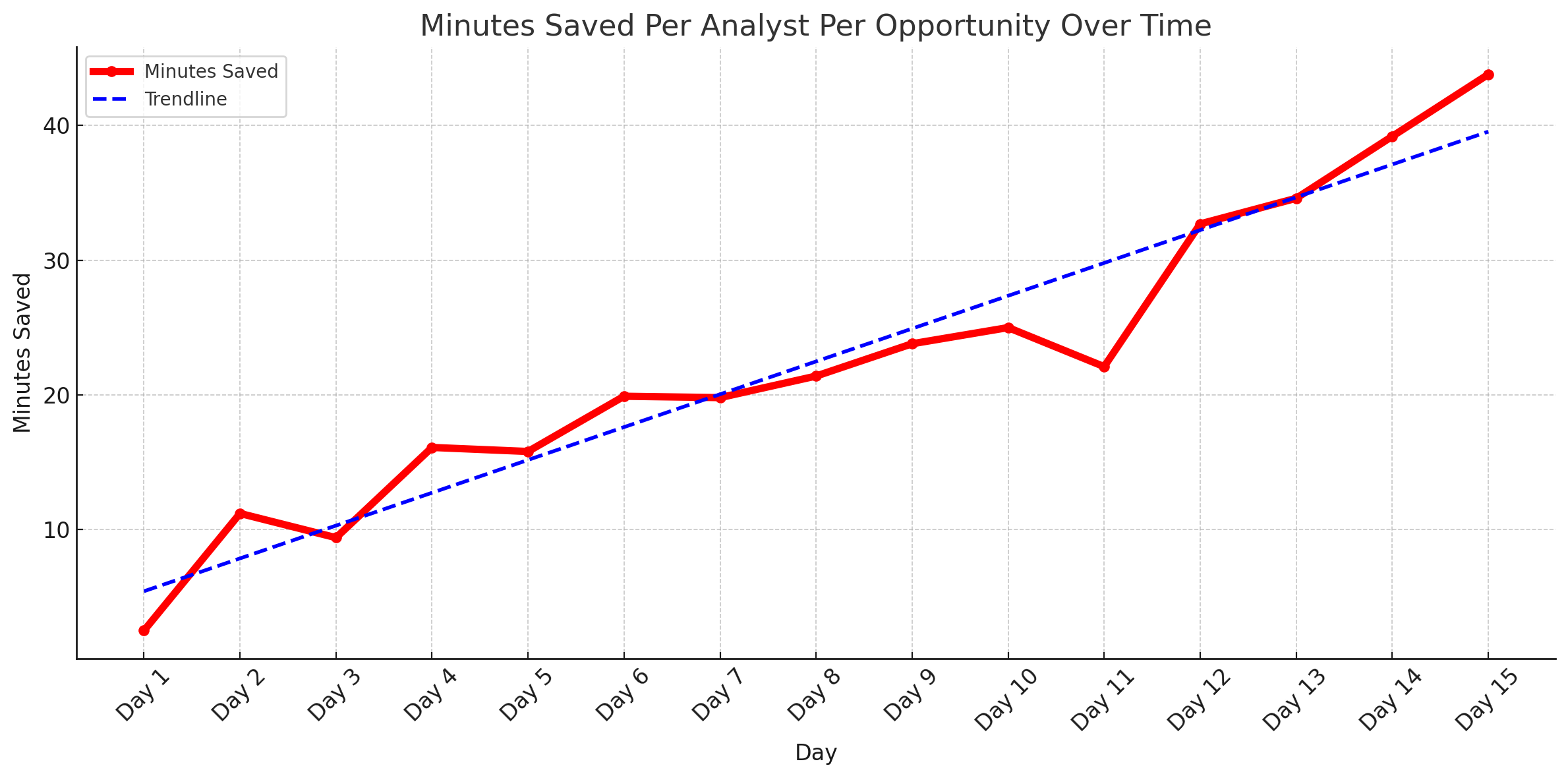
A pilot ran against the team's normal workload, with minutes saved per analyst on every opportunity measured over 15 days. We tuned the comparable selection where analysts overrode it, then opened the workspace to the rest of the deal team.
THE RESULTS //
Measured on live deals…
73%
Gain in research productivity
4.5%
Higher IRR
43.8min
Saved per analyst on every opportunity
Why it matters
- Valuations are more accurate because comparisons are current and checked automatically
- Analysts spend their time on judgment calls instead of data collection
- Shorter deal cycles put capital to work sooner, which improves returns
- The system is built to take on new asset classes and regions as the business grows
Due diligence used to be the slowest step in Private Market's deal process. Now it's an advantage, letting the team move on a promising company before other investors have finished their models.